
Good Morning from my Robotics Lab! This is Shadow_8472, and today I have a game I’ve started making with a side of working on my homelab. Let’s get started.
The Pitch
AstroRush
A re-imagining of the classic asteroid-blasting arcade staple, this simple 3D space shooter puts you in the cockpit of a nimble spacecraft pulverizing asteroids in search of their mineral wealth. But is humanity alone in its interest in the Alpha Centauri system?
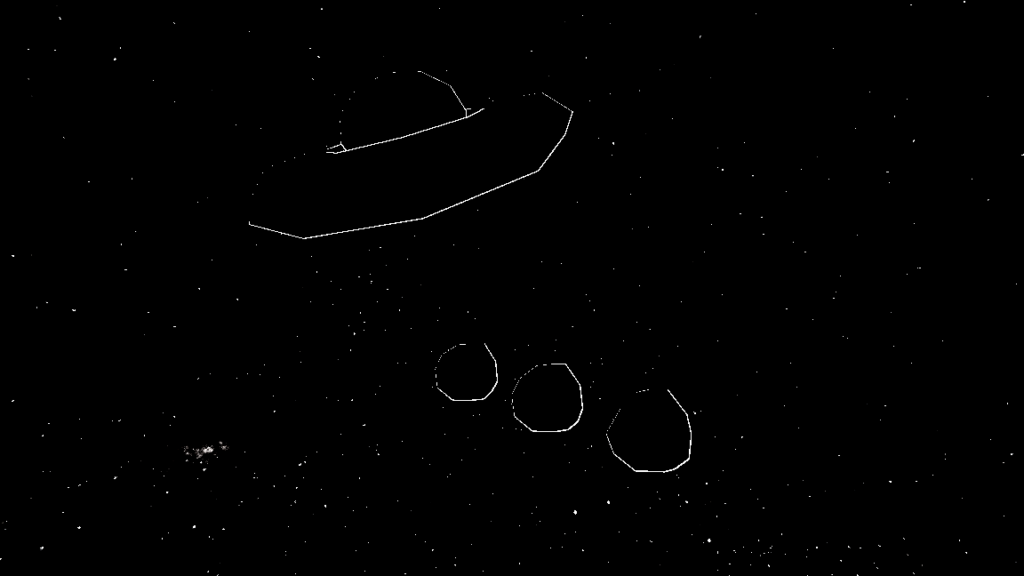
Styled to resemble vector graphics of the inspirational Atari title, Asteroids, AstroRush is my first game in my lineup to build my skills toward expressing my Container Analogy in an interactive format.
Progress so far
First off, I’m building this game on Redot 26.1, a free and open source game engine forked from Godot to provide a more stable base. The project recently moved from a “soft fork” to a “hard fork” – meaning that backwards compatibility with Godot is no longer a concern. The word I heard is that Godot introduced breaking changes in a minor update, which generally is a big no-no.
Moving on to AstroRush. It’s a working title I came up with to replace “Asteroids 3D” for this post – a pun off of “asteroid” and “gold rush.” The story I have in the back of my mind is that humanity is building its first inter-stellar colony, and all precious minerals are required.
Development proper started by grabbing my free flight controller and a picture of the sky from NASA for my background. I got the composite of the starry sky to feel like it could be drawn by an arcade game by turning down the saturation and maxing out contrast in the environment node.
And then most of my time was spent on dead ends trying to get the look just right. This category is split into two sections: first is shaping the asteroids, the second is outlining models with all-black albedo. To shape the asteroids, I first made a vertex shader to nudge around the points of an Ico Sphere out of Blender. The naive approach of displacing each vertex gave me a “nacho explosion” where each triangle goes off on its own. The trick was using the values at a 3D noise texture as a seed. But I found I could only make one unique asteroid using this method.
My second approach was to build the same logic in code. It took a bit longer, but again found that the last mesh defined was being used for everything. This is particularly problematic, as I need meshes to scale for larger/smaller asteroids. I ran my code past the Redot community and learned the engine was working as intended; I had made erroneous assumptions from the documentation. At this point, I’m likely to just “bake” a series of meshes that can be assigned randomly as needed.
Extrapolating the visual style of Asteroids to 3D was probably where I wasted most of my time. After trying and failing to write an outline shader for myself, trying to work with the stencil buffer (turns out it’s listed as experimental, and subject to change), and searching for a pre-made outline, I circled around to one that worked sort of OK, but didn’t particularly like low-polygon games as I was working with.
I wanted to understand the structure of the shader I was working with, so I spent a day re-building it as a visual shader – translating each line of shader code into a form resembling a flow chart. For some reason, I was never able to get it to behave the same as the original, even when I rigged the relevant parts into an “expression” node made for handling code. Yeah… those appear a little buggy at the moment.
Around this time, I was playing with a widgit in the Redot interface when I noticed a pattern in the misbehavior with the outlining. All I had to do was vertex deform the outline mesh as well.
Working on the free flight controller, I found speed caps and drag for both rotation and lateral movement helped with the feeling of a responsive space ship. Without them, turns are a fight against velocity. Think: Kerbal Space Program. I’m also working on making the script more friendly towards using it in other games. That means extending it using a second file.
Takeaway
It will take time, and progress will be incremental as I learn the basics. I still don’t have a playable prototype. Is the game fun? I don’t know. I sure hope so. But as the code base grows, I’m going to want a local Git server in my homelab.
I am thankful for the Redot community being so chill because the Godot Discord has reportedly gone on a witch hunt – banning people over common opinions the moderation team considers hateful – be they expressed openly, in a profile you have to hunt for, or in a leaked DM. No mercy, no notification – just a ban, according to some Redot users I met. Assuming it’s all true, I have to say it’s sad. On the one hand, I believe they hurting themselves. On the other, Freedom of speech is not freedom of platform. They have every legal right to build an echo chamber, but I find it morality dubious at best to eject people for wrongthink when they are otherwise behaving.
Final Question
What would you call this game?